A traffic jam at the intersection of interactivity, aesthetics, epistemology, and semiotics
Monday, February 27, 2012
Unsustainability, History, and Fuck-You-Nomics: Part I
Thursday, January 26, 2012
Monday, January 9, 2012
Goals, Games, and Stories
Writing a blog post on Microsoft Word makes me feel like I’m writing a paper of some sort, so all of this formal language keeps coming into my head. Even writing this sentence in MSWord is a bit weird, but if I don’t remind myself that this is for the blog, I’ll continue to write as if I had some thesis to prove (laugh track.)
But anyway, I was going to talk about The Sims. I was having a conversation with a friend the other day and I think that he hit the nail on the head when he complained that it was Taylorist. I’m not the expert on Taylorism, but it’s generally a philosophy that dominated workplaces a few decades ago by emphasizing repeated motions and compartmentalized processes that maximize efficiency at a given task. Think McDonalds—its “killer feature” being that it made food much more efficiently by using an assembly-line process in which every person does a single task. Yum!
Now, in particular, it went across that same line of reasoning a lot of us may have about the game—we obsess over making our characters eat breakfast and go to work, forgetting that we’re asking them to do the most mundane things that we’re generally avoiding by playing video games. Of course the catch is that we generally don’t operate the same way in real life—eating breakfast, going to work and engaging in seemingly rote self-improvement are generally situated in something other than a single-minded numbers game. I admit, however, I’ve fallen into that trap, and I think many others have; where the idea of self-improvement escapes any sort of idea of life and mindfulness and we suddenly hope to sit down for a few hours and mindlessly repeat some rote task while increasing some theoretical gauge or meter. And, yes, it’s a horrible way to think about life.
And this is where I think The Sims truly fell short of being a great game despite its being one of the most popular of all time. By the way, I’m only talking about the first one, I haven’t played the sequels. But I digress; a truly great game constantly demands that we make decisions of strategic depth—this means that the challenges are always somewhat novel and that there are few (if any) stretches of performing the same task repeatedly. Nor is it even that such repetition makes a game potentially boring, but rather the horrible serotonin trap that can come out of it. There are those times where I can keep getting a little kick of happiness from repeating some action and getting some minimal amount of feedback. When I give one of my Sims a promotion at work or an extra skill-point, there is a slight jolt of satisfaction that reinforces the sense of reward that will come when I pass the next tiny milestone.
What’s important to me about this dichotomy between the rote and the novel isn’t so much what it says for creating a game with great gameplay, but what it means for creating a game that offers a true narrative experience. As I’ve said before (though maybe not on this particular blog), what separates games from other mass media (if you consider games a mass medium—hard to say when such a popular thing is only taken seriously by a narrow demographic) is that it doesn’t offer any sort of real storytelling. Yes, there are backstories, cutscenes, characters, allusions and motifs within games, but most of these things are cosmetic and not at the core of the experience; even the occasional deeper theme that pervades gameplay only scratches the surface of what a real story will deeply penetrate.
As I write this I am in the passenger seat of a car, riding down a stretch of highway connecting Boston to New York, anticipating the sights of big buildings upon my eventual entry into the FDR drive. I’m listening to “Kids” by Kelli Ali—a song with lyrics that semantically mean little more than noise to my rational mind—but the ambience and percussion behind the vocalist’s low and breath-like voice brings about a feeling of mystery. It is the opposite of what Taylorism, rationalism, utilitarianism, classical economics, score cards and every other measurement that’s been mistaken for reality stands for. The soundtrack to a movie that doesn’t exist—but one that I wouldn’t want to exist anyway; a movie that maybe one day I can borrow a few scenes from but leave the rest in the unprocessed ether of the unstructured and the uninterpreted.
This is, of course, the instinct that art and storytelling invoke in us. Nobody gives a shit how many midichlorians Luke Skywalker gains between A New Hope and Return of the Jedi and when I watch Mad Men, I’m hardly thinking about Peggy Olsen’s iron march of progress (though it goes without saying that I’m rooting for her—she’s one of the only decent people at the agency.) But they do have something in common with even the most stereotypical video games, they have goals; that is, goals of a certain nature. We see change over time, infer motives in characters and follow a journey. It’s just that this journey is of an entirely different nature than that which is stamped, filed, indexed, briefed, de-briefed and numbered; it’s one in which the path matters more than the destination—what more mathematical types would call “path dependent.” At its core, it refuses to acknowledge gain without loss, pleasure without pain, joy without melancholy—a far cry from the one-track “pursuit of happiness” (as defined by what the game tells you it is) that The Sims beckons us to.
This isn’t to say that games never offer anything similar to this experience. We can satisfy the simple desire to see interesting things happen by turning up the difficulty a notch higher than we usually would, modifying the game, or (a la The Sims) treating the game like a dollhouse in which we create dramas. A medium is a means of transportation: sound through air, a signal through a telephone wire, meaning through language, a story through a novel, a vision through a painting; so at its core, this “dollhouse” idea is how the process of storytelling operates on some very deep and fundamental level—the reflection of our mind, our environment and our shared cultural discourse off a medium.
But the tools for this kind of exploration are currently insufficient for an experience that even comes close to what I can experience by turning on a movie, opening a book or listening to a song. I want to imagine a game in which people can experience this exploratory mode of play with the full spectrum of behaviors, desires, motives, personalities, webs of causality, empathy, mystery and dramatic weight that we see in stories. Perhaps game isn’t the right word—“game” in the more academic sense of the word meaning known probabilities and mathematically defined sets of outcomes. Whatever I may want to call them, it’s time to embrace the notion of goals, motives and desires that can be understood but not classified—they need to be open-ended; a catalyst rather than some suffocating essence that defines the experience. Motives are as fundamental to both stories and games as symbols are to both narratives and maps; a narrative being an open-ended set of ideas and symbols rather than a strictly delimited abstraction.
Parts of this post, such as those bits about exploration vs. destination, felt so obvious and banal, but that isn’t what’s most important to take away. What’s important is to make this distinction in a way that doesn’t throw the baby out with the bathwater. Goals, motives and desires are at the core of both the most rote gameplay and the most beautiful poetic landscapes—but in making a new kind of “game”, we must embrace it in a different way while still preserving the core ideas behind gameplay. There really is an area between story and game.
Tuesday, November 15, 2011
The Entropy of Morality
Tuesday, November 8, 2011
Paradigms vs. Narratives
Monday, September 26, 2011
Truth
Wednesday, August 3, 2011
A definition of narrative?
My structural definition of a narrative:
A collection of events* that makes sense of itself without the use of axioms.
*Was hesitant about using the term "event", but I think that it's more precise than saying "signs"--there's a self similarity here I think; the idea of an event is itself inscribed in narrative.
Thoughts?
Thursday, June 23, 2011
That Old Humanities Argument
As an English major in college, I had to struggle with this question myself; I was asked by other people and even had to deal with the prompt in a literary theory class (which I utterly failed at doing.) It is worth noting that a lot of my work in literary theory has been applicable to what I'm engineering now, but that's besides the point to me because I know that it wasn't all that this was about. I certainly see literature as an important metaphysical experiment for philosophers, but I don't know how I feel about philosophers either.
But around a year ago I had read about Stanley Fish's book Save the World On Your Own Time, which apparently* argued that trying to find some political or economic justification for the humanities denigrates it by denying the idea that it may just be good in of itself (does everything really come down to money and survival?)
While I was taking a break today that line of thinking crossed over with all the time that I've spent thinking about Edmund Burke and Nassim Taleb and it dawned on me that I had been missing the obvious for years; that perhaps the importance of literary criticism is in the fact that despite having no explicit justification for it, we still continue to read, teach, analyze and deconstruct stories; value a supposedly "arbitrary" literary canon, ask questions about things that never happened and give interpretations in the absence of right or wrong answers.
To me, asking why we value literature, spend so much time teaching it to students and even have tenured academics who spend their whole life studying it is like asking why we have religion or inauguration ceremonies or act hold doors open for other people. At this point, it's tradition and part of a deeper logic that we can't ever presume to understand--a point made tirelessly by Edmund Burke in the wake of a disastrous French revolution based on simple top-down models. Simply put, I don't think that the world would be better off if we stopped holding doors for other people and I don't think that we'd be better off not studying literature.
On a more concrete note, I think it is possible to glean the value of literary criticism and it is related to the importance of things beyond economic concerns. We live in a world richly populated by cultural phenomena. Being part of that world means understanding our cultural heritage and our shared idea of what it is to be human (cliche, I know, but isn't it true?) Would you refrain from teaching your kid table manners or how to talk to elders?
Whether it's through high school English, Hebrew School or wrestling in the grass with your classmates, we all have and all need rites of passage. Part of the humanities is spiritual training, the rest is something else.
----------------------------------------------------------------------------------------------------------
*No, I haven't read it, just making that clear. A second-hand summary did in fact raise some interesting points for me.
Monday, June 13, 2011
Childhood
Friday, June 3, 2011
Friday, March 4, 2011
Sunday, February 27, 2011
Men In Black
Saturday, February 26, 2011
EDIT: I just realized that the only way I can articulate my defense of religion is with these little vignettes. I have an idea of why, but I don't want to get into a long essay about it (talk to me—or leave a comment if you're interested in that sort of thing.)
Friday, February 25, 2011
The Garden of Platonic Forms
Literature has no platonic forms, invalidating the underlying assumption since Aristotle that literature is a way to bring us closer to Platonic forms (Plato believed that poetry and drama was "thrice removed from nature", meaning that it was an imitation of an imitation; but Aristotle believed in the power of poetry/drama to bypass the limitations of Earthly manifestations.)
Structuralism was the most rigorous* way of doing this, but eventually saw its own limits; thus becoming a study of this very cycle of interpreting and then finding new meaning by figuring out how the interpretation contradicted itself or simply didn't apply. Perhaps that's why I have as hard a time as the French understanding any real difference between structuralism and post-structuralism.
--------------------------------------------
*Please take "rigorous with a grain of salt.
Sunday, February 13, 2011
Two Social Psychology Observations
Thursday, February 10, 2011
If On A Winter's Night...
Thursday, December 30, 2010
The Poverty of Online Information
Also, I have no idea why the font is being so screwy.
*****************************************************************************
There are three concepts that, when one looks closely enough, can be seen as a single indivisible triad: narratives, context and memory. They all fundamentally deal with an associative way of thinking and they are noticeably robust: one doesn’t easily forget things (my cousin and I still occasionally debate who was at fault in a scuffle we had when I was seven) and we seem to understand things best when they’re told as a story. They also have another trait in common: they are often lacking if not non-existent when I try to find information from the internet.
Take Wikipedia as an example. It certainly has a wealth of raw information; just about anything one can think of seems to have an article, whether your interest is in hermetian matrices, hardcore bands, Lacanian psychoanalysis or Pokemon trading cards. Even so, I never feel the same sense of fulfillment reading material on Wikipedia that I get from reading a book; I often find myself struggling to walk away with something to hold on to after browsing through this seemingly infinite pool of collective knowledge.
Maybe I’m just of a dying breed of people who hold on to physical books, but more universal reasons seem to be at play. Our brains work in an associative manner; rather than record our memories in a serialized manner like a video camera or a computer’s hard drive, we create memories by connecting various objects, sensations, thoughts, images, sounds and other past experiences. Conversely, we recall memories from the past by seeing, hearing, feeling or thinking something that we’ve associated with it; anyone remember the scene that everybody talks about from Swann’s Way where the narrator takes a bite of a Madeline cookie and his entire past rushes back at him?
A single sensation or reference brings back a rapid cascade of memories and this same phenomenon underlies what might be our memory’s inherent preference for books: we associate its content with the distinct look and feel of the book’s cover, pages, printing, wear and tear. Simply put, you can remember something much better when you attach it to a physical object of some kind.[1] But just as the physical context of knowledge may matter more than we think, so too might the relevance of that knowledge to some larger narrative. The journalist Malcolm Gladwell might oftentimes be criticized for the lack of empirical rigor behind his theses, but I prefer any one of his books to a series of entries on Wikipedia because I believe him to be a masterful storyteller able to weave a larger number of data, anecdotes and ideas into a single story that makes sense of them. Knowledge is much more easily remembered when there is a narrative that brings it all together.
One way of thinking about this is that a narrative introduces redundancy to knowledge. It’s much easier to remember an idea when it’s linked to a number of other ideas as part of a larger theory. If you learn something in a vacuum, there will be nothing to give you any clues to it should you forget it; but by relating it to something else, we have something to remind us of the original idea.
But is it really the case that there are no narratives on Wikipedia? If I look up David Bowie, I’ll find a summary of his life and career and with it there will be hyperlinks to more detailed summaries of particular works or to biographies of his contemporaries; there’s definitely a narrative. Even so, there’s something about Wikipedia that is too summarized and distilled to be the kind of story that sticks well after I’ve finished reading an article. It offers not so much a story as a summary in which details are relegated to the various articles that it links to.
But these links on Wikipedia are inadequate to finish telling the story. They are details that are told in a complete vacuum, unaware of the fact that I came from a page talking about one thing and not another. In Malcolm Gladwell’s Blink, the defeat of the United States Navy 7th Fleet at the hands of Paul Van Riper’s meager force in the 2002 Millennium Challenge War Games is talked about in the context of how human intuition can be more powerful than the world’s greatest computers, but a Wikipedia article summarizing the thesis of Blink could only tell it in sufficient detail by providing a link to an unrelated page summarizing the incident; one that would fail to have the interpretive richness of Malcolm Gladwell’s own retelling.
A story, as opposed to a simple summary or functional narrative, speaks to us about what is not obvious. Whereas summaries compress, stories interpret by bringing together a wealth of information and constructing a unique idea. Furthermore, through this same process of bricolage, a story is filled with a rich variety of prose and impedimenta that allow us to create a rich network of associations and have an experience that is eminently memorable. A summary, as a simple compression of one or more stories, simply doesn’t have the same informational richness as those stories and as such cannot create the strong mnemonic associations that stories do.
At the end of the day, storytelling is something that is hardwired into us. We comprehend and remember things as stories, not data, and the tradition of storytelling has been a universal ritual as far back as recorded history takes us. This natural affinity of ours towards telling stories can teach us a lot about how we learn and should be taken into consideration as we expand our educational tools into the domains of the internet and cloud computing. The ability to express ideas as dynamic and interactive programs as opposed to static texts and the interconnection of vast amounts of user-created data will doubtless allow us to inform and educate in novel ways; but these innovations must cultivate the human faculty for storytelling if they are to be truly effective as pedagogical tools. As our world becomes increasingly interconnected and hyper-abundant in information, context has become the essence of knowledge; and one cannot understand context without understanding stories.
[1] For further reading on this idea, see Nassim Nicholas Taleb’s notebook, Opacity (http://www.fooledbyrandomness.com/notebook.html)
Saturday, November 20, 2010
Narratives are for Socialists!
Human cognition arose from having to infer increasingly complicated patterns (for those who might get the wrong idea, this is not a logical kind of inference—it's pattern recognition in the brain.) Originally, pattern recognition was developed in order to provoke the kind of response along the lines of "Holy shit, a rattlesnake!".
As primates evolved, they became more sophisticated organisms that also worked in groups. These groups involved social relationships far more complex than schools of fish or flocks of birds (which are quite nicely simulated by programs such as Boids). In order to facilitate these social interactions, members of the group needed to traverse these in an effective way, thus the individual organisms needed to become more intelligent with regards to social interactions.
Now, this kind of intelligence had much different demands than those of basic sequential reasoning, which was first the basis for being able to competently hunt down an animal and eventually for the kind of sequential logic that gave rise to civilization. If you now turn your attention to stories, it's pretty notable that the vast majority of stories are re-tellings (fictional or otherwise) of social interactions; more so when I think about the fact that the only narratives devoid of social interactions (that I can think of) are from modern times.
If this is true, then it's safe to say that stories were originally about people. Stories also have their own internal logic and form that is very different than the kind of modularized rationalist thinking that we usually associate with knowledge. My take on this is that this unique logic was crafted over time in the human mind in accordance with the nuances of social interactions. Rather than try to learn about social interactions through empiricism, which would get your slow-thinking ass killed in the jungle, the human mind developed a vast and messy network of heuristics for comprehending social interactions—in simple terms, we developed an intuition for how people work and were able to express it to one another by means of storytelling.
But why telling stories? Why not just understand social interactions in some way on our own? Two reasons. First, there's an obvious advantage to being able to communicate this knowledge to the rest of the group—to tell one's kids why they shouldn't lie to other people or why they should stay away from the other tribe. Second, being able to transmit and modify this knowledge presents another huge advantage: just as biological evolution embraces random change as a means of creative destruction, having the capacity for storytelling allowed for traditions and arguments between people that allowed stories to change in unexpected ways. Those that were keepers stuck around and those that didn't have much value could be weeded out in time.
Since then, we've been given a large and intractable network of storytelling traditions, genres, themes, allusions and so on; all of which is worth studying, by the way. At some point, I might post about how narrative evolves, since narratives are built on other narratives through two concepts talked about by Jerome Bruner known as canonicity and breach. But I'll leave that for another time.
Friday, October 22, 2010
Why Intent "Matters" (or: why Beyonce is a bad liar)
Second, the opposite view is equally dogmatic and flawed. This is the harder point to make and I'll start by extolling some of the virtues of this view before kicking it down a notch.. A peer of mine once brilliantly said about analyzing Lolita "If we were to bring Nabokov back from the dead to ask him what he intended, he'd probably just pop out of his grave and start lying." This is quite true on many levels; on a quite literal level, there's no way you can guarantee an honest statement of intent; just because an author is saying it as opposed to writing it or phrasing it in a direct manner rather than an indirect manner (i.e. telling a story, what a concept!) that doesn't make it any more of a foundation since it isn't verifiable.
I can take this further by saying that intent simply isn't verifiable. It has no objective existence; you can tell your best friend what your intent about writing a story is and then lie to everybody else, but what you said to your best friend doesn't have any objectively verifiable basis; it only exists in your head! This seems somewhat banal, but it's a less metaphyiscal way of stating the fact that subjective ideas can only be mapped, they cannot be verified.* So it would seem that talking about intent is silly; it doesn't objectively "exist", it's something we can only infer in some unquantifiable way by privileging someone's "direct" statements or by looking at the biography of an author and using our idea of what their life was like to suggest how some events may have informed their work.
But this argument seems a bit weak. Is anything in literary interpretation ever objectively verifiable? Answering "yes" to that question seems absurd (if you think otherwise, feel free to speak up; I'm just saying that right now I really don't see any good argument.) So what are we doing then in analyzing literature? We're making sense of its impact and its relationship to the world by constructing a narrative of our own. While others may have strongly disagreed with me on the following point, I'll still make it: narratives are fundamentally about people and primarily reflect our existence as social creatures. When we read a novel or watch a TV show, we socially construct characters from the words on the page or the actors on the screen despite what's most likely a complete poverty of information; we may not know the entirety of their (imaginary) life experience, but just like a famous author, we construct a narrative from a limited biography (and body of canonical works; After the Quake isn't representative of Haruki Murakami, I swear!) and create a being with a life of its own.
One of the most important factors in our social construction of human beings is the idea of intentionality. We infer intentions when it comes to everything people do; perhaps as a way of masking all of the noisy details and deviations of a person's behavior or maybe because we really can learn who to trust and who not to.** Without ascribing intentions, we can't construct a picture of a person or empathize with someone; thus the reason why a heroic or tragic story on the news will captivate us but a statistic can only glance off the (somewhat) rational surface of our minds. The same goes for literature; not just in constructing characters but also in how we construct the story as a whole. There is always a narrative voice telling the story, however passive or indirect; and just as we listen closely to a personal story told to a trusted friend, we "listen" to a piece of literature in order to figure out what to make of the story it contains.
To put it another way, every story always has a storyteller; implicit or otherwise. Our idea of the storyteller is informed and constrained by many things; social norms, the conventions of genre, the idea that they're trying to entertain us (think about the last mystery/thriller you saw; you have a pretty good idea of why the most obvious suspect wasn't the traitor/murderer/villain,) and so forth. A former professor of mine rightfully responded to this point by bringing up the point that many of these ideas are different than a mere statement of intent because we can create a more objectively verifiable case about things like social customs and generic conventions. I agree with them insofar that making blanket statements about what someone intended isn't a good way to make an argument; our idea of someone's intention is as subjective as the author's own intent and an argument requires definite common ground. I still find it necessary, however, to acknowledge that we ultimately create an interpretation of the story that is itself a narrative and in order to do that we create an intent behind the storytelling. But I digress.
All storytellers are actually implicit; even if we know the author or are listening to an orator right in front of us, we don't know every last detail of that person's life, we've constructed a simplified version in order to relate them to the story that they're telling. The point is that this implicit storyteller informs our own effort to make sense of the story and in order to let such a storyteller inform us about the story we endow them with intentionality.*** Storytelling is fundamentally a social enterprise; it depicts complex social relationships (to the point that we can hate Nina Meyers for killing Teri Bauer) with very little information and it makes an impression on us by allowing us to read into how the story is told. From an evolutionary (and completely hypothetical) perspective, stories began as a means of communication about complex social relationships and so we're always scrutinizing the storyteller who must have borne witness to the events and who must have some motive behind telling us the story. But I (once again) digress.
We can't read a story without inferring something about the storyteller's intent and we can't have any understanding of a story without imagining a common ground between ourselves and the author. This is why Beyonce's songs will never do it for me. She talks about guys leaving her in so many of her songs (Single Ladies, Why Don't You Love Me, Say My Name...) but she's been dating Jay-Z for practically all of her adult life and is now married to him. I can't see veyr much authenticity in what she's saying. Jay-Z never left her and she started dating him when she was 21, so it seems unlikely that she has much to be going off of.
People have asked me why I continue to enjoy Lady Gaga despite the seeming artificiality of her songs about partying and seduction (she was a workaholic in school and is more of one now.) That's a good question. I suppose that most of Lady Gaga's songs in The Fame seemed somewhat reflexive and ironic to me. I know that's not a very sophisticated critique, but the difference is that Beyonce, for all of her singing and dancing talent and her picture perfect looks, just comes off to me as too damned earnest for her to have any implicit commentary in her lyrics. Of course, this is just the Beyonce that I've imagined for myself; the truth is that I don't know the first thing about her, and neither does anybody else outside of her personal life.
-------------------------------------------------------------------------------------------------
*My amateur knowledge of phenomenology and semiotics causes me to think that this statement suggests the respective roles of both schools. Semiotics is the study of mappings whereas phenomenology is the study of where mappings come from.
**To be fair, narratives were much more reliable back in the Pleistocene when the world wasn't so damned interconnected. I take no credit for this idea; see The Black Swan by Nassim Taleb.
***A stronger argument that I'm tempted to make is that this idea of the implicit storyteller is necessary to create any sort of narrative context; generic conventions, social customs and even the specific language/dialect that we're reading in is some subjective phenomena independent of the physical text (how could it be a physical property of the text?) that we see as an act of communication between teller and listener. To put this in a more familiar perspective, Peirce concluded that all signs require three elements: a signifier, a singified and an interpretant. Without a social construction that binds the storyteller (imagined or not) and the listener, there's no code with which to link sign and signified.
Tuesday, October 12, 2010
Data vs. Narrative
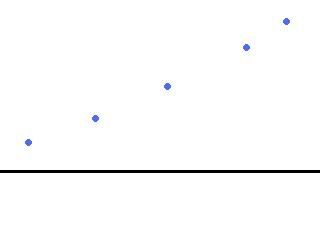
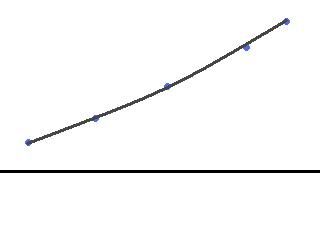
So, let's first take care of why I'm bringing up this question in the first place. What's the point of comparing and contrasting data and narratives? Well, a narrative is, generally speaking, a way of making sense of some series of events. It illustrates causality (note to literary theorists: please bear with my questionable simplification; part of the use of this is understanding narratives better, this is just a good starting point.) If narratives explain why something happened, then they may be able to tell us something about what's going to happen next. By this definition, it's really no different than a scientific hypothesis (literary theorists: just keep running with it). More simply, we can think of this as being given a bunch of data points and connecting them with a mathematical function of some kind; i.e. fitting them to a curve:

Some data...

And a narrative to explain it!
I should make a note that it's perfectly acceptable that these narratives could be wrong. A new data point could be shown that doesn't fit with the curve that I drew, thus forcing me to draw a new curve. In fact, there are an endless number of curves I could draw to fit those points; some of which may look exactly the same close up but wildly different when you zoom out. As an interesting side-note, this illustrates pretty well what Wolfgang Iser calls the inexhaustibility of the text. What I mean by this is that when reading a book, one creates a "world" inside their head that matches what they've read; but there are an infinite number of "worlds" that could match this, with any number of (currently) unnecessary ideas unconsidered. As the reader continues, they find new statements in the book that have to be accounted for either by changing previous assumptions or by adding new details to the "world" that they've created in their head.*
So why is a narrative not just a scientific hypothesis or some formula that matches a bunch of data points? The answer can be found in part of my digression; that as we read a text, we have to consider new details in evaluating what's going on and why. A more mathematical analogy is that we have to consider more semantic dimensions; we might read a book that takes place in a Castle, and at first we only have to know the general outline of a castle, but then when the book describes how it made the characters feel alone and vulnerable, we then have to think about ways in which that castle may look or be built that would invoke that kind of a feeling. This all might be very abstract, mind you, but it still works that way on a fundamental level. Also; and this is important, the details that we come up with in the future are going to depend on the details that we've imagined now; so the set of details to be considered are not just latently laid out in the text in some finite way, the details we consider are actually going to derive from each other. So the semantic dimensions (or types of detail, for the less pretentious) are not in any way pre-determined and there could be a potentially infinite amount of them.
Data, like the sample points I showed in my illustration, is different. There are exactly two dimensions to be considered when fitting a line to these points. We already know the entirety of the semantics. Data is entirely delimited; we don't consider things outside of the traits that are enumerated, and there are values specified for each of these traits on every point. Lines drawn to fit the data are ultimately built to fit a static sign system that never changes (I hoped not to have to use the word "sign system", but I don't know how else to explain that.) But once again, there's a catch that might pull data and narrative back together, which I believe to have unknowingly been the source of conflict in a debate I had on this subject with a good friend:
Even if the points exist in a single, unchanging sign system (unlike narratives, in which the sign system changes in unpredictable ways), there's still the question of the scientific hypothesis or the line that fits the curve. Scientific data and points on a chart may both be delimited, but the hypothesis or the function isn't really. Oftentimes, a scientific discovery is made by thinking outside of the conventional data analyzed and therefore the sign system of why the data points are generated in a certain way changes. Similarly, with a mathematical function, the way in which the data points are arranged may require you to add increasing amounts of complexity to the functions; you may add another degree to the polynomial or add a trigonometric function, or something else entirely. So the actual hypothesis/function actually does have a surprising amount in common with narratives in that there is a potentially infinite amount of semantics that can be added.
The difference is that whereas a text is unexhaustible, there isn't the case with a set of data; the hypothesis that's suggested doesn't change the attributes of the data that have to be accounted for. There is an argument from literary theorists, however, that essentially says that as you find these new hypotheses, you create a new paradigm in which the attributes of the data are better changed to fit it and that therefore you have the same intractability as solving a narrative. As tempting as it seems to accept this counter-argument, it still seems to be the case that while new paradigms might introduce new ways of formatting the data, scientific hypotheses still account for the old delimitations; or else it's just solving a straw-man for all intents and purposes. Personally, this argument doesn't interest me, so let's move on to something more important:
The question on my mind from the beginning of this has been one about hypotheses and it'll take a moment to explain. New hypotheses are constantly created from new observations that may have nothing in common with the data. For example, a theory in microeconomics may spring from something in psychology that is not in the paradigm of economics; so it wouldn't show in the data, but it may be the only thing that explains the economic data. Now, let's think about how we perceive the world. When we look at the world, everything is data; our senses send discrete electric imuplses to our brains that quantify our experience as data; the semantics of our sensory experiences are finite, so how do we experience narratives, how can things be inexhaustible?
The answer lies in our neurology. The many inputs and outputs of our brains are interconnected through webs or neurons; these connections being associations between observations. These create clusters of connected neurons we know as ideas. These new ideas which are formed from connections between observations (and also from other ideas) create new conceptions of meaning that we couldn't even hypothesize about before, therefore offering us a process akin to the text in which we can create a virtually unlimited number of narratives starting with the finite amount of data that we initially perceive; in other terms, we can now draw hypotheses from outside of our our original paradigm of experience. Add to this that changes in this web of neurons essentially changes the inputs and outputs into our system (we may still have the same sensory receptors, but they get processed differently as they go further through our cortex) and we've created the reading process in which we connect data with meaning and then re-define data according to that meaning, therefore creating new semantics from semantics that we ourselves had previously created; our experience becomes inexhaustible.
I wasn't sure if I'd get to the end of this one, *phew.* It got a bit obscure near the end (my ability to write clearly is waning with my focus), so if anyone wants me to clear anything up feel free.
-------------------------------------------
*For those interested in this concept, I talk more about it in my earlier entry about the movie Inception. You can also read Iser's original theory in his essay The Reading Process: A Phenomenological Approach.